
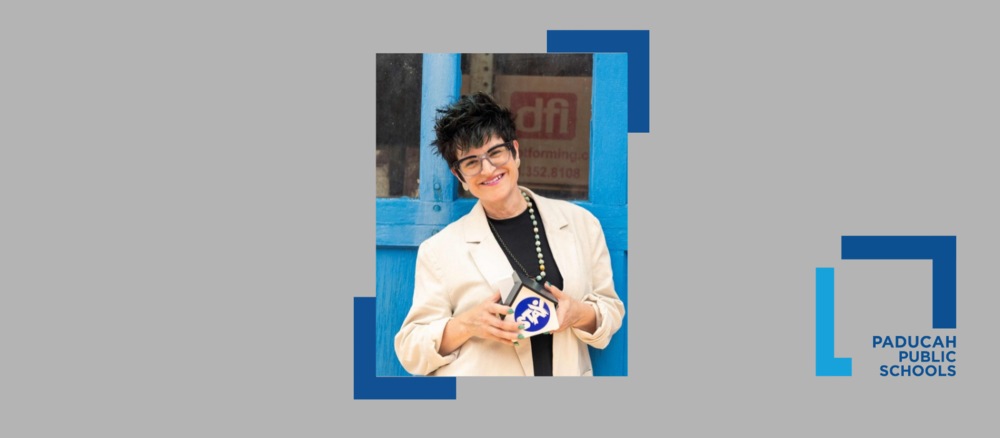
by Ben Overby
The Paducah Sun
October 21, 2026
Used with permission
Heather Anderson — McKinney-Vento liaison for Paducah Public Schools — has spent 13 years assisting students facing homelessness in the district through the School and Transition Assistance for Youth program.
Anderson is this week’s Paducah Bank Changemaker.
“Homelessness doesn’t always look like what people picture,” Anderson said. “It can mean students and families living in hotel or motel rooms, staying on a couch or in a car, or on somebody’s floor. It means living in shelters. Most people have the idea that it’s an old grizzled man who’s pushing a shopping cart with a cardboard sign, and that’s really not the full picture of homelessness. What we do is we make sure to remove any non-cognitive barriers to school attendance, like transportation. Here in our office, we have washers and dryers. We have a food pantry. We have a clothing closet and hygiene items. So we’re just we’re trying to fill in the gaps.”
Prior to taking over the role, Anderson was a special education teacher, but she said she’s always had an interest in social justice and housing equity. She said every day leading the STAY Program looks different with the great variety of services they offer.
“We do anything from ordering birth certificates for students to hanging out with families who are doing laundry and building relationships with them,” she said. “We have a crockpot program that we do, so there are times we’re delivering food where we have lots of people in our office. We’re making sure that students are enrolled immediately in school, and part of that is that we’ve got to make sure that their immunizations are up to date, that they have a school physical, and we can do that all here at the school.”
Anderson said one of the most crucial parts of the program is building relationships with students and families.
“We want them to know that we are here to serve them and to help them be successful and to thrive, and if that relationship’s not there, then they won’t trust us to give whatever aid they need,” Anderson said. “It’s a two-way street. We find a lot of times that adults or young people know a lot about the things going on in town and what’s available, and they can kind of mentor us through a few things, and we’re so appreciative of our students and families when they’re like, ‘Hey, did you know this was going on? Did you know this was available?’ The relationship part of this program is very important to us.”
She said it’s also crucial to make sure the program is always evolving to students’ needs. She said that includes constant needs assessments for the food pantry and making sure they’re operating in a way that serves families best.
“For example, we’re trying to buy a new minivan because we transport a lot of students, and our current van is just not big enough,” she said. “We’ve got to cram kids in the back, and we just want to make sure everybody’s comfortable and able to talk to each other. That’s one of the really fun things about in the mornings and the afternoons is all of our students talking to each other, getting ready for the school day, and hyping each other up. With our laundry room, we always need detergent and dryer sheets, and with the food pantry, we’re in constant need there because people have got to have things like ground beef and lunch meat. We’re just constantly thinking about people’s needs and asking our families and students what they need and taking that into account.”
She said one of the most rewarding aspects of her work is seeing people in the program graduate high school.
“When you’re experiencing homelessness, a lot of times school becomes the least important thing because you’re trying to survive,” Anderson said. “Are you worried about having a pencil that day if you don’t have anywhere to stay? No, you’re not. So seeing students be successful in school is extremely rewarding. I have a former student who we just went down to Florida to see. He graduated from college, has a great job down in Florida, and he’s now pursuing his master’s. So it’s so great to see success stories and to see students who go straight into the workforce and do really really well, or go into the military and do well.”
Anderson said over her years in the position, she’s seen an increase in the need for services with many people losing housing, and the increased ability to identify students facing homelessness. She said the program served over 300 students last year, double from the previous year. She said people can reach out to her at 270-816-4670 for information on how to donate or help with the program.
“I think something that everyone should know is that homelessness is a situation,” she said. “It’s not who the person is, and that’s why we say ‘experiencing homelessness.’ The majority of my families — they work, they’ve fallen on hard times, and that really could happen to any of us. So homelessness is a circumstance, not an identity. Our students and families are so much more than that circumstance. They’re resilient, they’re brilliant, and fun to be around.”