
by Ben Overby
The Paducah Sun
June 16, 2026
Used with permission.
The Paducah Public Schools Board of Education discussed the district’s recognition as one of the six in Kentucky excelling in math performance improvement for third through eighth grade students in the years following the COVID-19 pandemic.
Will Black, assistant superintendent for Paducah Public Schools, presented the data from Education Scorecard — a collaborative research effort between the Center for Education Policy Research at Harvard University, The Educational Opportunity Project at Stanford University and faculty at Dartmouth College, comparing student achievement across districts and states through an advanced methodology. Kentucky as a whole ranked eighth in the nation in math recovery between 2022 and 2025, while the districts recognized alongside Paducah Public Schools for math improvement were Harlan, Grayson, Franklin, Johnson and Boyd Counties.
“This report really focused on third through eighth grade, but as you know from last year, Tilghman also made a big jump in math, especially between 2024 and 2025,” Black said. “What was really exciting, as I shared earlier this year, is that we really saw systemic improvement across all three levels: elementary, middle and high, but we saw improvements even among subgroups, so it wasn’t just one group of kids. What we saw is improvements among all students, pretty much all groups that are typically measured by the state.”
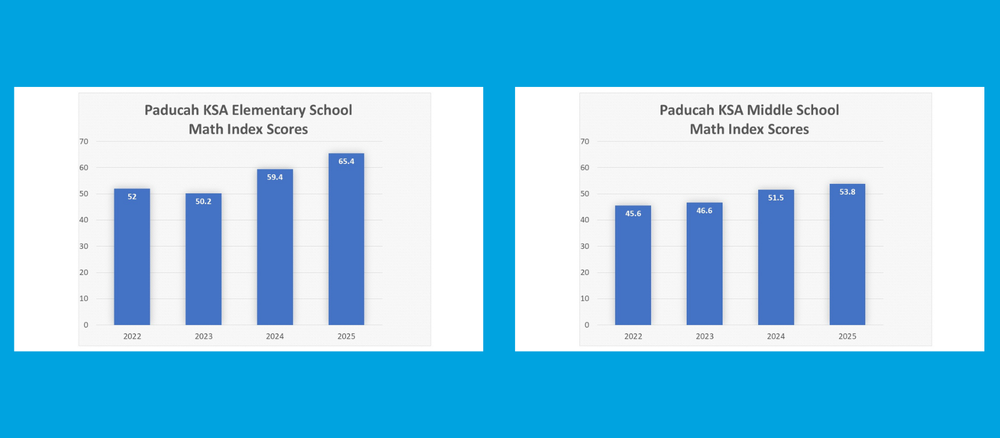
Paducah KSA middle school math Index scores rose from 45.6 in 2022 to 53.8 in 2025, with average elementary scores rising from 52 to 65.4 over the same period. Subgroups that saw systemic improvement included African American students and economically disadvantaged students.
Black credited High-Quality Instructional Resources — i-Ready Classroom Math for elementary schools and Carnegie Mathematics for middle school — and training teachers on those resources with improving scores.
“In the past, we have had effective math textbooks, but they weren’t completely aligned to Kentucky standards,” Black said. “These resources are much more aligned than we’ve ever had. Also, I would say we have implemented a formative assessment system that allows us to track student achievement throughout the year, and we can see in real time what students have mastered and what they need more help with. That’s very helpful. That enables us to give students what they need by the week, and that certainly helps make their learning more efficient.”
Black said to continue improving math scores districtwide, Paducah Public Schools wants to continue efforts to coach teachers to implement High-Quality Instructional Resources effectively and leverage teachers’ knowledge to share with each other.
“I’m very thankful to all the administrators and the teachers in our district for all their hard work,” Black said. “You can have all the best programs in the world, but if you don’t have effective teachers applying what they’re applying their expertise to the use of those programs, you really don’t get the kind of gains that we’re getting. So very thankful for the collective effort of our staff, and very proud of our students.”
Clark Elementary Principal Kelly Workman and McNabb Elementary Principal Teresa Spann were both present at the meeting and were pleased to hear about the data regarding improved scores.
“I was excited, but then not surprised, because we have been extremely intentional with hiring and retaining the best,” Spann said. “Specifically at McNabb, I’ve been focused on growing math teachers, really looking at the hiring process and seeing who has a math background, so that has been part of that. Also, the professional development that we’ve given each teacher, meaning that’s not just at McNabb, it’s all three elementary schools working together.”
Workman praised the I-Ready Classroom Math system, one of the forms of High-Quality Instructional Resources, saying it creates more options for students.
“We’ve seen a significant improvement because there are so many different strategies,” Workman said. “Everybody’s finding their niche in how to do things, and a student may not solve it the same way you and I do. I-Ready is giving them other options to learn how to solve different types of problems, so it’s going beyond just math skills. It’s giving them those critical thinking skills as they mature and get older and progress through the grade levels.”